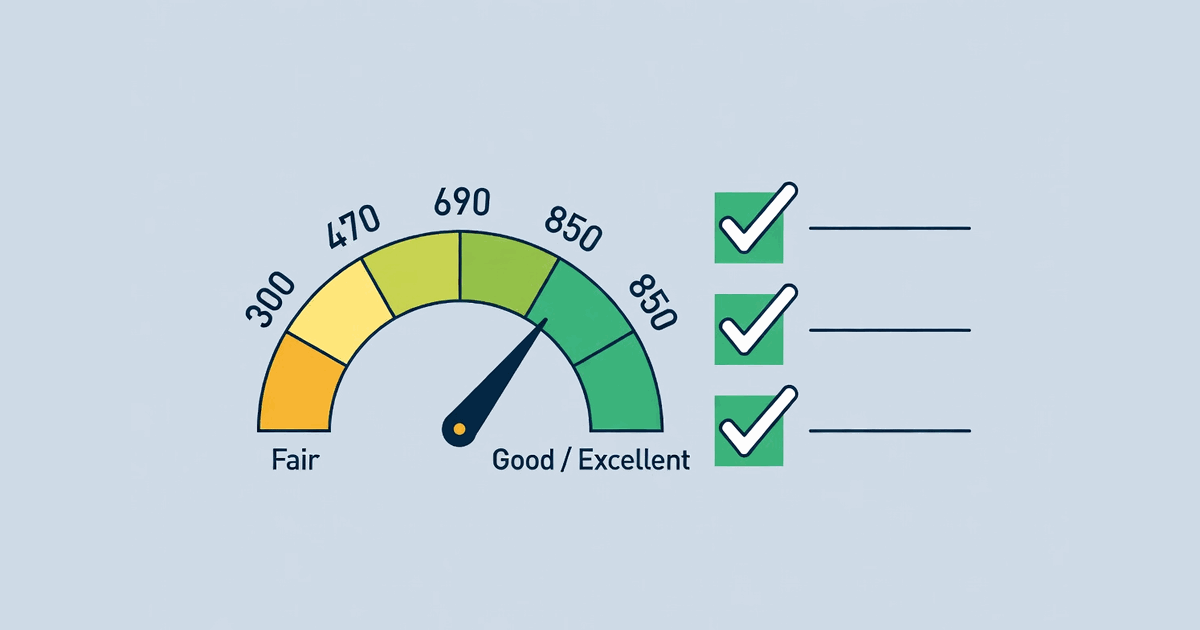
A higher credit score quietly lowers the cost of almost everything you borrow. It can mean a better interest rate on a mortgage or car loan, a higher chance of approval for an apartment, and sometimes a lower deposit on utilities or a phone plan. The encouraging part is that a credit score is not a mystery number handed down at random. It is calculated from a defined set of factors, and once you understand those factors you can move the score deliberately rather than hoping it drifts upward.
This guide breaks down what actually drives your score, then walks through the changes that produce the largest gains. None of it requires paying a “credit repair” company. The work is straightforward, and the most important steps are free.
What your credit score is really measuring
Most lenders in the United States look at a FICO Score or a VantageScore, both of which run from 300 to 850. The score is a snapshot of how reliably you have handled borrowed money, distilled into a single number that predicts how likely you are to repay a new debt on time.
The two scoring companies weight the information slightly differently, but they pull from the same underlying credit reports kept by the three nationwide bureaus: Experian, Equifax, and TransUnion. According to FICO’s own published breakdown, your score is built from five categories, and they do not count equally (myFICO — What’s in Your Credit Score).
| Factor | Approximate weight | What it reflects |
|---|---|---|
| Payment history | 35% | Whether you pay bills on time |
| Amounts owed (utilization) | 30% | How much of your available credit you use |
| Length of credit history | 15% | How long your accounts have been open |
| New credit | 10% | Recent applications and newly opened accounts |
| Credit mix | 10% | The variety of credit types you manage |
Once you see the weighting, the priorities become obvious. Payment history and amounts owed together make up roughly two-thirds of the score, so that is where your effort belongs first.
Step 1: Never miss a payment
Payment history is the single largest factor, and a missed payment is the fastest way to undo months of progress. The Consumer Financial Protection Bureau is blunt about this: paying your bills on time, every time, is the most important thing you can do to build and keep a strong score (CFPB — How do I get and keep a good credit score?).
A payment is generally reported as late once it is 30 days past due, and that single mark can stay on your report for up to seven years. The practical defense is automation. Set up autopay for at least the minimum amount on every credit card and loan, then treat any additional payment as a separate step you make on purpose. Autopay guarantees you never cross the 30-day line by accident, even during a busy month.
If you have already missed a payment, the recovery is to bring the account current and then keep it current. The damage from a single late payment fades over time as more on-time payments accumulate behind it.
Step 2: Lower your credit utilization
The second-largest factor is “amounts owed,” and the number that matters most inside it is your credit utilization rate: the percentage of your available revolving credit that you are currently using. If you have a $10,000 total limit across your cards and your statements show $4,500 in balances, your utilization is 45 percent.
Experian notes that people with the highest scores tend to keep utilization in the single digits, and a widely cited rule of thumb is to stay below 30 percent, with lower being better (Experian — What Is a Good Credit Utilization Rate?).
There are three reliable ways to push utilization down:
- Pay before the statement closes. Card issuers usually report the balance on your statement date, not after your due date. If you pay down the balance a few days before the statement closes, a lower number gets reported.
- Ask for a credit limit increase. If your limit rises and your spending stays the same, your utilization drops automatically. Request increases on accounts you have managed well.
- Keep old cards open. Closing a card removes its limit from the calculation, which can push your utilization up overnight even though you spent nothing.
Utilization is recalculated every time new balances are reported, so this is the factor that can move your score the quickest, sometimes within a single billing cycle.
Step 3: Check your credit reports for errors
You cannot fix what you cannot see. Errors on credit reports are more common than people expect, and an account that is not yours, or a payment wrongly marked late, can hold your score down for no reason.
You are entitled to free copies of your credit reports from all three bureaus through the official government-authorized site, AnnualCreditReport.com (Federal Trade Commission — Free Credit Reports). Pull each report and check four things: that every account belongs to you, that balances look right, that no on-time payment is marked late, and that there are no unfamiliar inquiries.
If you find a mistake, dispute it directly with the bureau that lists it. The bureau is generally required to investigate, and correcting a single reporting error can lift your score without any change to your actual borrowing behavior.
Step 4: Be deliberate about new credit
Every time you apply for credit, the lender usually performs a “hard inquiry,” which can shave a few points off your score temporarily. One inquiry is minor, but several in a short window signal risk and add up.
This does not mean you should never open new accounts. A new card can raise your total available credit and improve utilization over the long run. It means you should apply with intention rather than chasing every sign-up offer. When you are rate-shopping for a single mortgage or auto loan, scoring models generally treat a cluster of inquiries within a short period as one event, so do that shopping inside a focused window.
Opening several new accounts at once also lowers the average age of your credit history, which works against the “length of credit history” factor. Space out new applications and let your accounts age.
Step 5: Build history and a healthy mix over time
The remaining factors, length of history and credit mix, reward patience more than tactics. The longer your accounts stay open and in good standing, the better. That is one more reason to keep your oldest card active with an occasional small purchase rather than letting the issuer close it for inactivity.
Credit mix simply means lenders like to see that you can responsibly handle different kinds of credit, such as a revolving card alongside an installment loan. You should never take on a loan you do not need just to diversify, but if you already carry, say, a car loan and a credit card, that variety is quietly helping you.
For someone starting from a thin file or rebuilding, a secured credit card or a credit-builder loan can establish the on-time payment record that everything else depends on.
Common mistakes that quietly hold scores back
A few habits feel responsible but actually work against you:
- Closing a paid-off card. It feels like tidying up, but it removes available credit and can spike utilization.
- Paying late but in full. The “in full” part is good; the “late” part is what gets reported and hurts most.
- Carrying a balance to “build credit.” You do not need to pay interest to build a score. Paying the statement in full is ideal, and the on-time payment is what counts.
- Applying for store cards at checkout. The small discount rarely justifies a hard inquiry and a new low-limit account.
How long improvement actually takes
Credit scores respond on different timelines depending on the factor you change. Lowering utilization can show up within one or two billing cycles, while the benefit of a clean payment history and aging accounts compounds over months and years.
| Action | Typical time to see an effect |
|---|---|
| Paying down balances before the statement date | 1–2 billing cycles |
| Correcting a reporting error after a dispute | 30–45 days |
| Recovering from a single late payment | Several months, improving steadily |
| Building length of history | Ongoing, measured in years |
The pattern is consistent: the fastest wins come from utilization and error correction, while the durable gains come from simply paying on time and letting accounts mature.
A realistic plan you can start this week
Putting the steps together, here is a sequence that delivers the most improvement for the least effort:
- Turn on autopay for at least the minimum on every account so you never miss a due date.
- Pull your three free reports and dispute any errors you find.
- Pay your card balances down before the statement closes to lower reported utilization.
- Request limit increases on well-managed accounts, and keep old cards open.
- Apply for new credit only when you have a clear reason, and space out applications.
Follow that order and you target the two factors worth 65 percent of your score first, then protect the rest. Improving credit is less about clever tricks and more about a few consistent habits that, over time, reshape the number lenders see.
Frequently asked questions
How fast can I raise my credit score? It depends on what you change. Lowering credit utilization can move your score within one or two billing cycles, while rebuilding after missed payments takes months of consistent, on-time history.
Does checking my own credit hurt my score? No. Reviewing your own report is a “soft inquiry” and has no effect on your score. Only “hard inquiries” from credit applications can lower it, and only slightly.
Should I close credit cards I no longer use? Usually not. Closing a card removes its limit from your utilization calculation and can raise your ratio. Keeping the account open, especially an older one, generally helps your score.
Is carrying a balance good for my credit? No. You do not need to pay interest to build credit. Paying your statement in full each month is ideal, and the on-time payment is what improves your score.
Where can I get my credit report for free? Use AnnualCreditReport.com, the government-authorized source for free reports from Experian, Equifax, and TransUnion. Be cautious of look-alike sites that charge fees or push subscriptions.